If you have shopped for a Heap alternative, you probably did not start out looking for an analytics platform. You started out tired of begging a developer to add one more event. Somewhere along the way, "I want to track this button without writing code" turned into "I am evaluating a product analytics suite." Those are two different problems, and conflating them is how a lot of marketers end up paying for software that solves a problem they do not actually have.
This is worth slowing down on, because the choice you make here decides where your conversion data lives for the next two years. And where it lives matters more than almost anyone tells you.
What Heap is genuinely good at
Let me give autocapture its due, because the appeal is real. You drop one snippet on your site and Heap records everything: clicks, form submissions, page views, the lot. You do not decide in advance what to track. You define events later, on top of data that was already collected, which means you can answer questions retroactively instead of waiting weeks for a new tag to accumulate data. For a product team trying to understand how people move through an app, that is a legitimately powerful model. Define the funnel today, see last month's behavior immediately.
That is the pitch, and for exploratory product analytics it holds up. The trouble starts when a marketer adopts the same tool for a marketing job.
The part nobody puts on the comparison page
Here is the question that actually decides this: where does your conversion data need to end up?
For a marketer, the answer is almost never "in a dashboard I look at." The answer is "in the systems that optimize my ad spend." Google Ads and Meta do not bid well on vibes. They bid on conversion signals. The cleaner and faster those signals arrive, the better the machine learning gets at finding people who convert, and the lower your cost per acquisition drifts over time. Your tracking setup is not a reporting exercise. It is the feedstock for someone else's algorithm.
Autocapture sits in the wrong place for that job. Heap collects interactions into Heap. Your conversions live in Heap's data model, behind Heap's interface, on Heap's timeline. To get those conversions back out to GA4, to Google Ads, to the Meta pixel, you are now building exports, integrations, or a parallel tagging setup anyway. You bought a tool to escape plumbing and inherited a different set of pipes.
There is a second cost that is quieter but just as expensive. Autocapture records everything, which sounds like a feature until you have to find the signal in it. "Everything" is mostly noise. The handful of events that matter to your campaigns, a qualified lead, a started checkout, a completed purchase, are buried in a sea of clicks you will never report on. And the retroactive data that helps a product analyst is close to useless to an ad platform, because the platform needed the signal at the moment of conversion to act on it, not three weeks later when you got around to defining the event.
So the honest framing of "Heap alternative" for a marketer is not "find another tool that captures everything automatically." It is "stop solving the analytics problem and go back to solving the one you actually had."
The problem you actually had
You wanted clean, named conversion events flowing into the tools you already run, without writing JavaScript and without a developer in the loop. That is it. Not a new silo. Not a second source of truth your stakeholders will argue with GA4 about. Just the specific events that matter, landing where your ad platforms can read them.
That problem has a different shape than "analytics," and it has a different solution. The solution is to make Google Tag Manager do what it was always supposed to do for marketers: send deliberate events to GA4 and the ad platforms, on purpose, at the moment they happen. The reason most marketers fled GTM in the first place is that configuring those events by hand means CSS selectors, custom JavaScript for AJAX forms, and a debugging session that eats an afternoon. So they reached for autocapture to avoid the code. Reasonable instinct, wrong trade.
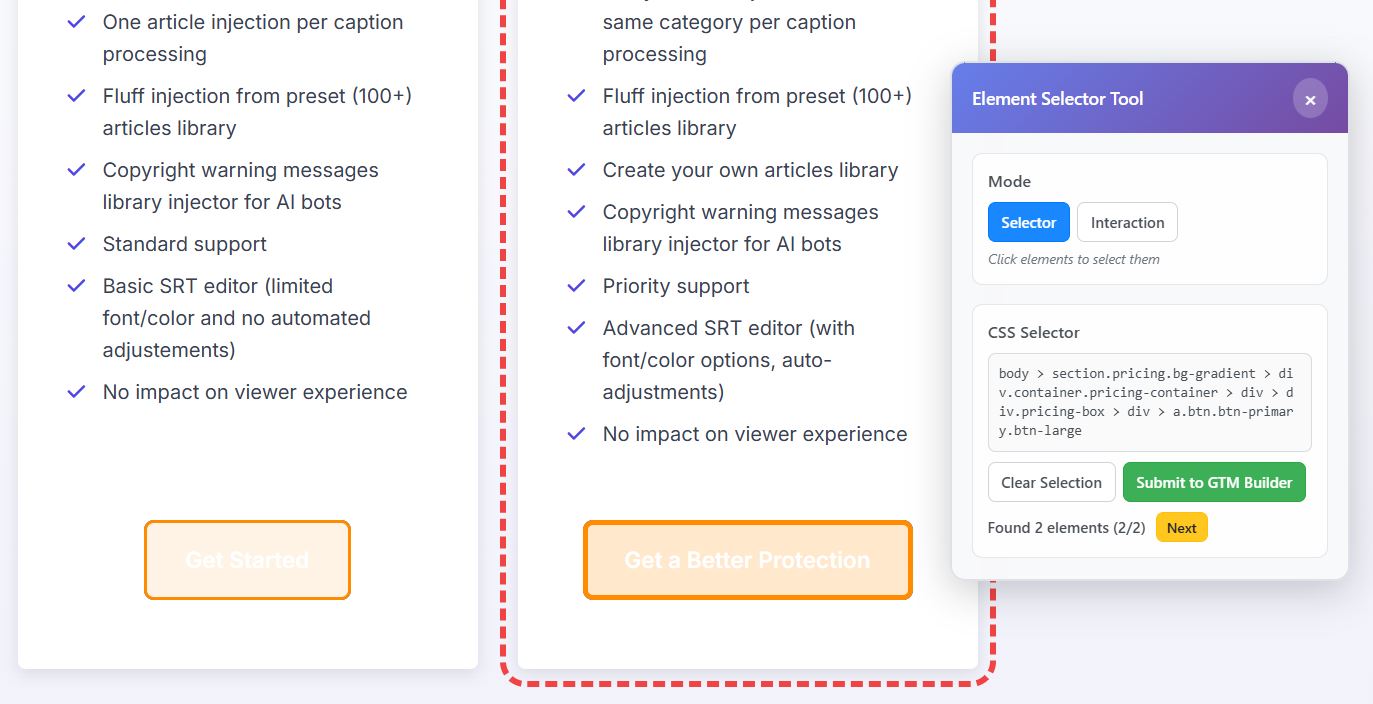
The better trade is to remove the code from the GTM path instead of routing around GTM entirely. That is the approach I built TagCompanion around: you point and click the elements you want to track on your own site, and it generates the GTM container file, tags, triggers, and the AJAX interception JavaScript included, that you import and publish. The events go straight into GA4 and onward to your ad platforms through the infrastructure you already own. No second platform, no export job, no silo. I mention it here as the concrete shape of the argument, not as the point of the article. The point is the principle: deliberate events in the systems that act on them beat captured-everything events in a system that does not.
When Heap is still the right answer
I am not going to pretend the choice is one-sided, because it is not. If you are a product team and your core question is how users behave inside a complex application over time, autocapture earns its keep. Retroactive analysis is a real advantage when you cannot predict in advance which interactions you will care about, and a marketing-style "track these five conversions" setup will leave you blind to the exploratory questions product work depends on. If that is your job, buy the analytics suite and do not look back.
But notice how specific that case is. It is a product analytics problem owned by a product team, not a conversion tracking problem owned by a marketer. If you are running campaigns and your success metric is cost per acquisition or return on ad spend, you are in the second camp, and the autocapture model is working against your actual goal even when it feels convenient.
Decide by where the data has to go
The cleanest way to settle a "Heap alternative" decision is to ignore the feature lists and ask one question: at the end of the month, where does this data need to be sitting to do its job? If the answer is "inside an analytics interface my team explores," autocapture is a fair fit. If the answer is "inside GA4 and my ad platforms, clean and named, feeding the algorithms that set my bids," then the tool that captures everything into its own database is the long way around, and the short way is deliberate GTM events with the code taken out.
Most marketers who go shopping for a Heap alternative are in the second group. They just had not named the job yet. Name it, and the right tool stops being the one with the most impressive capture and starts being the one that puts clean signal where it counts.